|
CS8800 Walking Profiler
Overview /
Hardware /
Software /
Technical Specifications /
Operator Computer /
Proof of
Performance

|
OVERVIEW
|
|
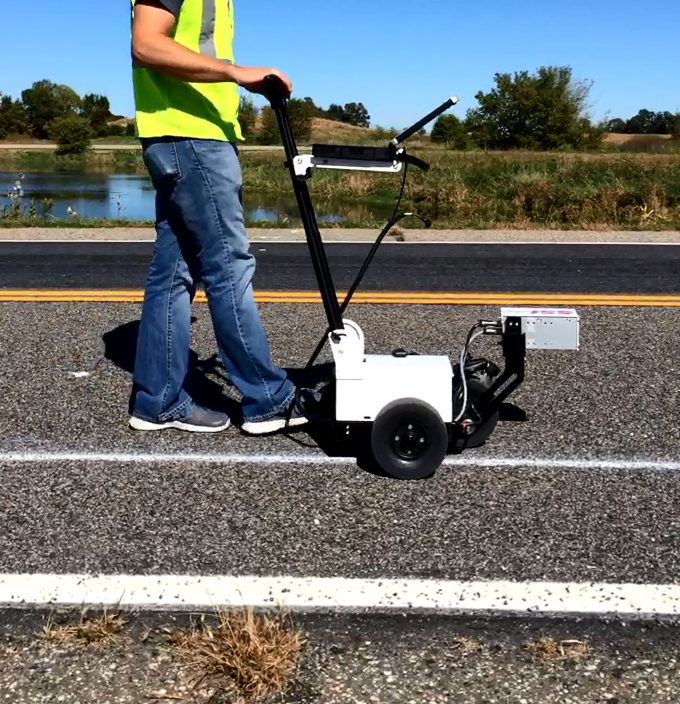
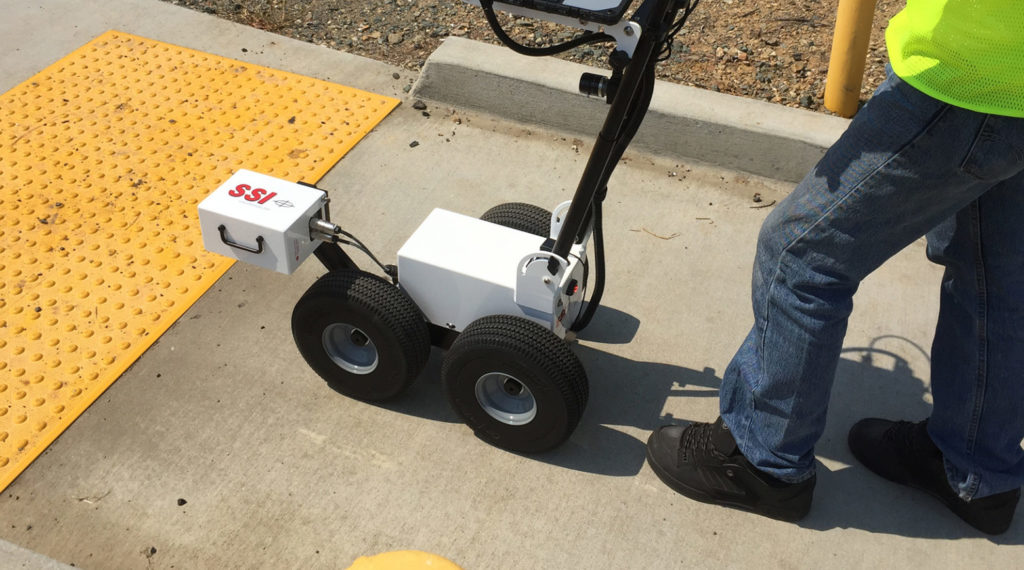
The CS8800 Walking Profiler measures the exact surface
profile of all types of pavement, and it can also output the
FF/FL (flatness/levelness) of floor surfaces. The
CS8800 has the proven ability to generate surface data that
is both highly accurate and repeatable. Manually
propelled at a walking speed, the CS8800 outputs raw data
that preserves incremental changes in height, distance and
elevation content recorded along the surface at a default
one-inch (25mm) sampling interval. Multiple output
formats are supported, including ERD/PPF (compatible with
ProVal), Excel, ASCII/CSV and PDF. The CS8800 is
supplied with analysis software for calculating all commonly
used ride indexes (IRI, PRI/PI, MRI, HRI and RN) as well as
precise detection of areas of localized roughness.
Vivid colorized images of profile traces are also displayed,
along with an embedded computational engine for statistical
comparisons between same surface data collections.
The CS8800 measures precise surface profile through an
optimized combination of electrical and mechanical
instrumentation. The sensors include high resolution
incline and position sensors, as well as a unique contacting
front arm apparatus that accurately captures short features
on the surface. The raw data is processed using SSIs
proprietary data filtering methods to precisely reconstruct
both short and long wavelength features with unmatched
precision. Localized roughness is also precisely
reported with separately adjustable templates to determine
the exact dimensions of bumps and dips along the surface.
Operated on military specification
Toughbook 19 touch-screen computer with easy full
featured Windows software programs, the CS8800 is built to
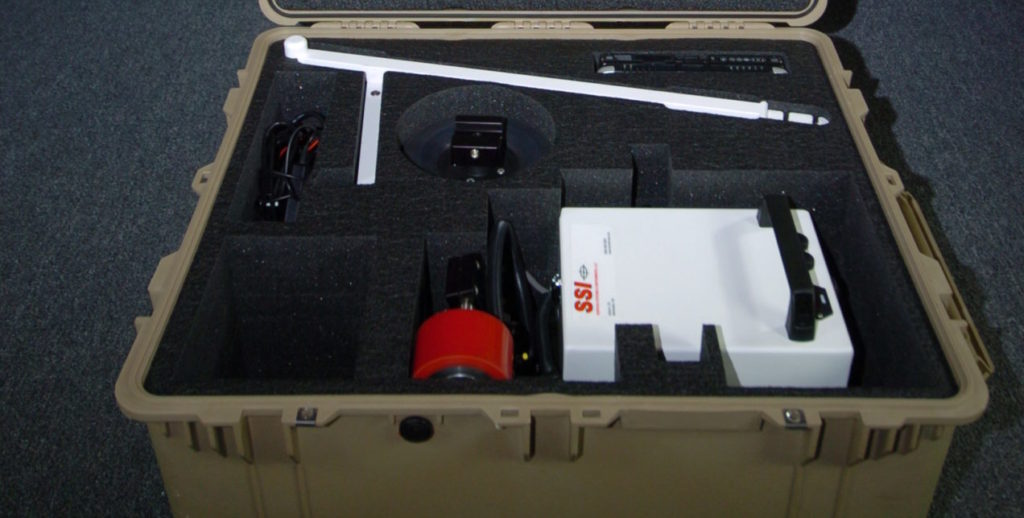
work with precision in harsh environments. The CS8800
collapses into a reusable container for storage and
shipping. Available options include integrated GPS,
(low resolution or survey quality) and three-dimensional
texture measurement with a lateral line scan laser (LMI
Technologies Selcom RoLine sensor or equivalent).
The CS8800 is offered for purchase or rental.
System rentals are available with or without a trained
operator.
|
|
Pictures:
(click to enlarge) |
|
(To view pictures, configure
your browser to allow pop-ups from
www.smoothroad.com)

▲Return to Top▲
|
|
|
|
|
HARDWARE FEATURES
|
|
Engineered frame hardware
with finishes designed to withstand harsh outdoor
conditions.
Redundant instrumentation (inclinometer and contacting
front-arm) optimizes measured profile.
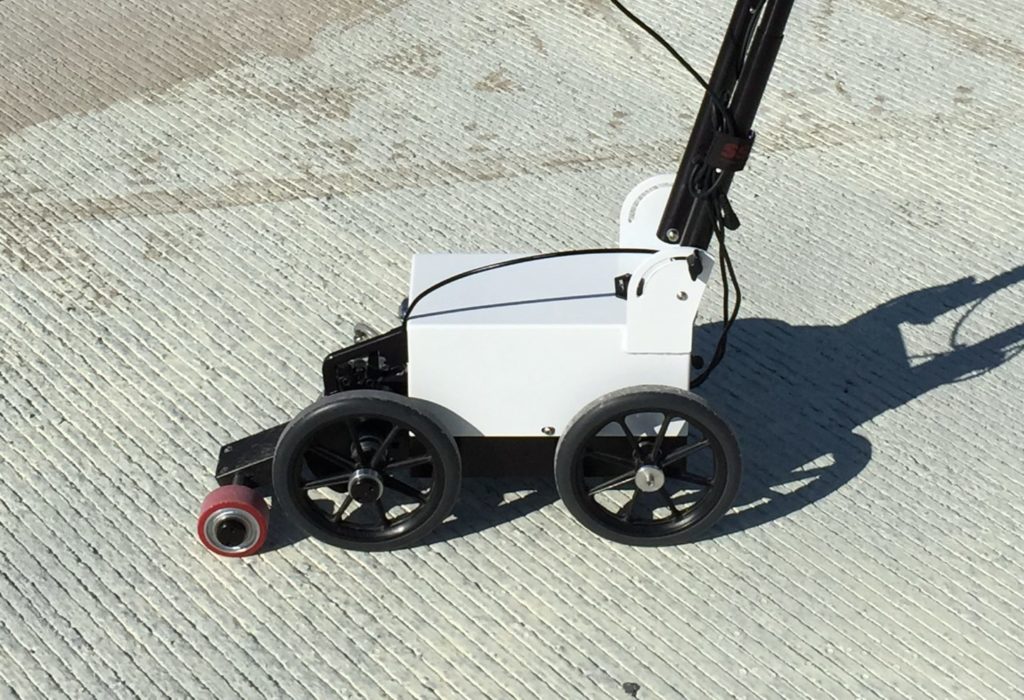
Contacting front arm apparatus (unique to CS8800)
preserves very short wavelength surface features.
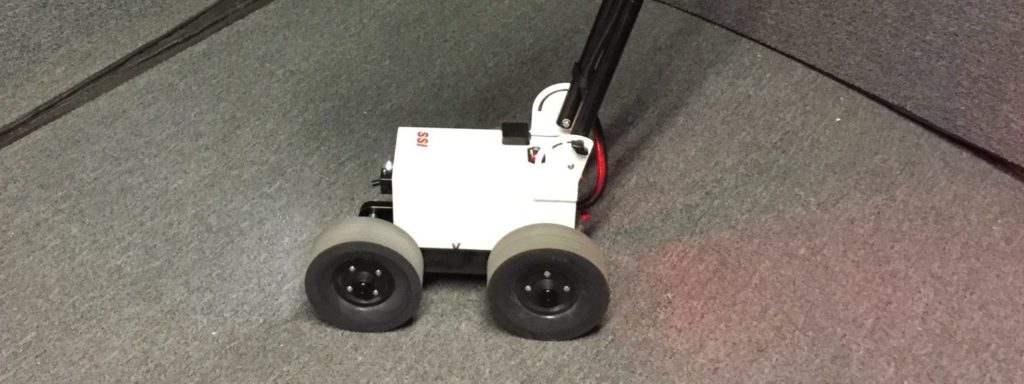
Adjustable outrigger support wheel for stability and
balance.
Wide true-round tires for ideal measurement footprint.
Durable urethane tires stay in-round longer and wear
slowly.
Internal Lithium-Ion battery specified for long duty
cycle (>10 hours of testing).
Gauge displays battery charge
level.
Modular design for in-field replacement of core
components.
Modular parts reduce downtime and reduce
support.
Data collection electronics fabricated in ISO 9001
facility.
Fast, simple assembly (only handle and computer need to
be attached).
Hardware collapses into reusable container for shipping
and storage.
Front and rear lighting for safety and visibility.
Panasonic
Toughbook 19 military specification operator interface
computer. MS-Windows 7 Professional operating system
and touch screen controls allow for fast operator training
and easy field operation.
On-site assistance available worldwide for first time
set-up, calibration, operator training and follow-on
support.
Low resolution GPS with coordinates integrated with
profile stations (chainage) and Google Earth images of
profiled areas (optional).
Survey resolution data and output formats supported with
optional integration with RTK corrected GPS or total
stations/laser devices.
High resolution three-dimensional texture measurement
with optional line laser (LMI/Selcom RoLine or equivalent).
▲Return to Top▲
|
|
|
SOFTWARE FEATURES
|
|
Easy Windows software
operates on touch-screen Toughbook computer (Windows 7 Pro
operating system).
Computer
instructed routines for system calibration,
data collection, analysis and reporting.
Real time
display of incrementing stations (chainage),
device speed, elevation change and profile
trace.
Walking
speed data collection allows faster testing
than other devices. (Best results with
slower speeds on rough or coarse textured
surfaces).
Default
sampling Interval = 1 inch/25mm.
Outputs data
equivalent to ASTM E950 Class I profiling
device.
Reports
IRI, PRI/PI, HRI, MRI, RN, Floor
Flatness/Floor Levelness indices, and exact
dimensions of localized roughness.
Instantaneous
test results and on-screen viewing of
profile traces and reports.
Multiple
profile trace reporting allows side-by-side
presentation of parallel profile traces
(patented by SSI) with ride index results
averaged.
Multiple trace output facilitates assessment
of roughness laterally across surface.
Open
(one-way) or closed loop data collection
methods.
Add
new data to existing files.
Stores
surface profile (longitudinal or transverse)
and elevation data for output in numerous
formats.
Multiple
data output formats supported [ERD/PPF for
ProVal, Excel (CSV or supplied templates),
and PDF images].
Profile
data can be viewed on-screen in field or
office, transferred electronically or
printed in hard copy.
Raw data
can be reanalyzed repeatedly with different
parameters (e.g. English or Metric units,
different profile indices, localized
roughness templates, data filtering
methods).
SSI
Validation Engine software for comparing
same surface profiles (for ongoing
assessment of CS8800 performance).
Encrypted
raw data assures security and integrity of
profile data.
Software
updates by Internet download (self-executing
updates overwrite prior versions).
Guaranteed
to meet or exceed industry specifications
and test methods.
▲Return to Top▲
|
|
|
TECHNICAL
SPECIFICATIONS*
|
|
Device Classification/Rating |
World Bank Class 1
Instrument.
Equivalent to ASTME950 Class 1
Profiling Device.
|
|
Data Outputs &
Reporting
|
Reports: IRI, MRI, HRI,
PRI, RN, CA Bridge, FF/FL (Floor Flatness/Floor Levelness),
and localized roughness (adjustable bump/dip templates or by
IRI thresholds).
Outputs: PDF, Excel, ERD/PPF
(compatible with ProVal) and raw strip trace.
|
|
Working
Surfaces
|
All pavement types and
textures.
Surfaces should be firm and
relatively free of stones or debris. Moisture or dust
on surface will not distort measurements.
|
|
Operating
Speed
|
0.0 to 3 mph (0 to 5 kph).
Walking pace, visual/audible warning for excessive speed.
(Note: slower speed recommended for best results on rougher
or coarse textured surfaces, and for preserving accurate
changes in elevation).
|
|
Localized
Roughness
|
Adjustable template for
reporting localized roughness by length and height of defect
areas. Bump and dip areas shown by station (chainage)
and location of maximum peak or trough amplitude.
IRI based reporting of
localized roughness.
|
|
Sampling
Interval
|
Default: 1 inch (25.4 mm).
Configurable sampling interval supported for custom
applications.
|
|
Core
Measurements
|
True profile; height and
slope versus distance.
|
|
Measurement
Units
|
English/Metric
(user-selectable; data is rewriteable to change in units).
|
|
Distance
Measurement Accuracy
|
+/- 0.025%.
|
|
Height
Measurement Precision
|
±0.0025mm (±0001 inch) per
254 mm (12 inch) wheel-base.
|
|
Profile
Accuracy
|
±0.381 mm (±0.015 inch) per
45.7 meters (50 yards).
|
|
IRI
Accuracy
|
±0 .05 m/km (± 3.0
inches/mile).
|
|
Correlation
with Survey Generated IRI
|
0.985 cross-correlation
achieved on 10 repeat same surface collections (0.1 mile /
161 m test surface marked with paint dots for consistent
device tracking).
|
|
Wavelength
Measuring Limits
|
~0.45 meters (1.5 feet) to
undetermined upper limit (beyond any relevant or useful
wavelength).
|
|
Maximum
Grade Measurement
|
1 in 4.7 or 12 degrees.
|
|
Minimum Path
Curvature
|
No worse than 15 meters (16
yard) radius.
|
|
Warm
Up Time
|
~10 minutes or less.
|
|
Power
Supply
|
12V Lithium-Ion main system
battery designed for duration of 10 or more hours of testing
time. Battery duration decreases when Toughbook
computer powered from main battery instead of internal
battery.
|
|
Weight
|
~40 lb/18 kg (without
Toughbook computer, battery or reusable storage case).
|
|
Dimensions |
34.5 (L) x 18.0 (W) x
12.125 (H) (collapsed, 36.5 with handle extended).
|
|
Temperature
|
Operating: 15-140⁰F
(-10-60⁰C) (subject to temperature induced irregular surface
conditions). Storage:-50-170⁰F (-30-75⁰C).
|
|
Data Storage
|
Typical notebook PC hard
drive (160-320GB) has capacity for ~300,000 miles (480,000
km) of raw profile data. Profile data transferable
through industry standard storage media (DVD/flash or
portable memory, email etc.)
|
|
Data Conversion
Formats |
SSI encrypted re-writeable
proprietary format. Export routines supplied for ERD,
PPF (ProVal), PRO, ProScan, Excel, and PDF images of profile
reports and traces.
|
|
Operator Interface
Computer
|
Military specification
Toughbook 19 with daylight readable Touch-Screen.
|
|
Operator Interface
Software
|
Microsoft Windows 7
Professional applications for calibration, data collection
and analysis. Feature rich software. License
supplied for Desktop computer use.
|
|
Printer Options |
Optional color sheet-feed
or encased thermal printer (with power assisted paper
take-up) available. Supported print driver
configurations include wired (USB) and wireless (802.11 and
Bluetooth).
|
|
* Specifications subject to
change without notice.
▲Return to Top▲
|
|
|
OPERATOR INTERFACE COMPUTER
|
|

Toughbook 19
Typical
Configuration:
Intel Core
i5-2520M 2.50GHz processor
with vPro
10.1" TF+XGA Dual
Touch Screen with Tilt/Swivel
320GB Shock
Mounted Removable Hard Drive
4GB RAM
(expandable to 8GB)
Intel WiFi (802.11
a/b/g/n), Bluetooth
Multiple Ports
(DB-9, USB, Ethernet, SD Memory
Card)
Windows 7
Professional
Toughbook
Preferred
▲Return to Top▲
|
|
|
|
|
|
CS8800 DATA REPEATABILITY,
ACCURACY & CROSS-CORRELATION
The SSI CS8800 Walking Profiler system has the proven
ability to generate highly accurate and closely repeatable
surface profile data. The graphs below were generated based
on comparison of CS8800 walking profile data consisting of
repeat data collections from the same surface. The images
below report results from six same surface data
collections(1) along a 541 foot (165 meter) concrete
surface. (2) Four categories of performance are
presented: (1) Proof of Accuracy, (2) Proof of
Repeatability, (3) Cross-Correlation of CS8800 Data, and (4)
IRI Test Result Comparisons.
1.
Proof of Accuracy
Figures 1 and 2 below show a comparison of
same surface data from the CS8800 compared
to independent survey data. The
accuracy comparison shown in Figure 1
depicts an excellent point-to-point
comparison between the various individual
collections, with no absolute difference
greater than 34 mils. Figure 2 shows a
close up comparison of CS8800 data (the blue
trace) overlaid on the reference survey
profile with exact precision. On a
running point-by-point comparison, the
accumulated difference between the CS8800
systems profile and the survey profile is
23.8 mils (0.0238 inches). This degree
of accuracy exceeds the requirements of the
most stringent DOT certification
requirements. Prior to delivering any CS8800
profiling system to an end user, SSIs
verifies that the collection system compares
against an independent reference profile
with an equal or greater degree of accuracy
than is required by agency specifications or
equipment certification requirements.

Figure 1:▲SSI CS8800
Profiling System Accuracy Results▲

Figure 2:▲SSI CS8800
Profiling System: Proof of Accuracy
vs. Survey Data▲
2.
Proof of Repeatability
SSIs CS8800 Walking Profiler system is
proven to also generate highly repeatable
profile data. A repeatability
comparison between the six same surface
CS8800 runs is shown in Figure 3.
There is excellent point-to-point
repeatability between the various individual
collections, with a repeatability statistic
of 99%

Figure 3:▲SSI CS8800
Profiling System: Repeatability of
Same Surface Collections▲
3.
Cross-Correlation of
CS8800 Data An
increasingly popular method of comparing
same surface data from profiling devices is
to compute a cross-correlation score rating
the agreement between the multiple profiles.
The CS8800 has demonstrated the ability for
very high cross-correlation scores. Waveband
correlation between six same surface data
collections is shown in the table below in
Figure 4. For purposes of this analysis, the
wavebands of interest are: (1) IRI waveband;
(2) Long (25-125 feet); (3) Medium (5-25
feet); and (4) Short (1-5 feet).
| Run 1 |
Run 2 |
Waveband |
| IRI |
Long |
Medium |
Short |
| 1 |
2 |
0.994 |
0.997 |
0.996 |
0.965 |
| 1 |
3 |
0.994 |
0.995 |
0.995 |
0.977 |
| 1 |
4 |
0.98 |
0.987 |
0.988 |
0.891 |
| 1 |
5 |
0.983 |
0.985 |
0.989 |
0.882 |
| 1 |
6 |
0.991 |
0.991 |
0.993 |
0.946 |
| 2 |
3 |
0.994 |
0.999 |
0.996 |
0.957 |
| 2 |
4 |
0.981 |
0.988 |
0.987 |
0.885 |
| 2 |
5 |
0.981 |
0.984 |
0.986 |
0.856 |
| 2 |
6 |
0.99 |
0.991 |
0.992 |
0.932 |
| 3 |
4 |
0.984 |
0.986 |
0.988 |
0.902 |
| 3 |
5 |
0.984 |
0.983 |
0.987 |
0.905 |
| 3 |
6 |
0.99 |
0.989 |
0.992 |
0.954 |
| 4 |
5 |
0.997 |
0.998 |
0.997 |
0.983 |
| 4 |
6 |
0.991 |
0.991 |
0.993 |
0.955 |
| 5 |
6 |
0.991 |
0.99 |
0.993 |
0.954 |
|
Average |
0.988333 |
0.990267 |
0.991467 |
0.9296 |
Figure 4:▲SSI CS8800
Profiling System: Cross-Correlation of
Same Surface Data▲
The waveband correlation is 99% or higher
in all wavebands except the short waveband,
which achieved an impressive 93%.
4.
Comparison of Same
Surface Ride Statistics
Figure 5 shows the IRI (International
Roughness Index) values for six same surface
data collections with the CS8800. The IRI
values are tightly clustered, with no run
differing from another by more than 1.6
inches/mile on an SSI proving ground surface
with a roughness content of about 215 inches
per mile (3400 mm/km).

Figure 5:▲SSI CS8800
Profiling System: Same Surface IRI
Comparison▲
___________________
Notes:
1Runs 4-6 were collected one
day later and with a separate CS8800 device
than was used to collect Runs 1-3.
2Analyses generated using a
maximum 5 inch (127 mm) shift profile offset
shift and 200 foot (61 m) Moving Average
High Pass Filter.
3The performance of the CS8800
and other surface profiling devices is
affected by variables such as device
tracking, operating speed and the magnitude
of roughness and texture attributes on the
test surface.
▲Return to Top▲
|